


A qualified plumber must carry out the installation.
50mm Flange Mount Model
Install XTEND elements in the same manner as standard resistive elements.
-
Do NOT allow water to enter the grub screw hole during installation.
-
Tighten the grub screw firmly using the supplied Allen key.
-
When replacing an element, it is recommended to replace the thermostat and sacrificial anode(s) at the same time.
-
Handle the thermostat carefully — knocking or dropping it can cause it to fail.
35mm Boss / Screw-in Model
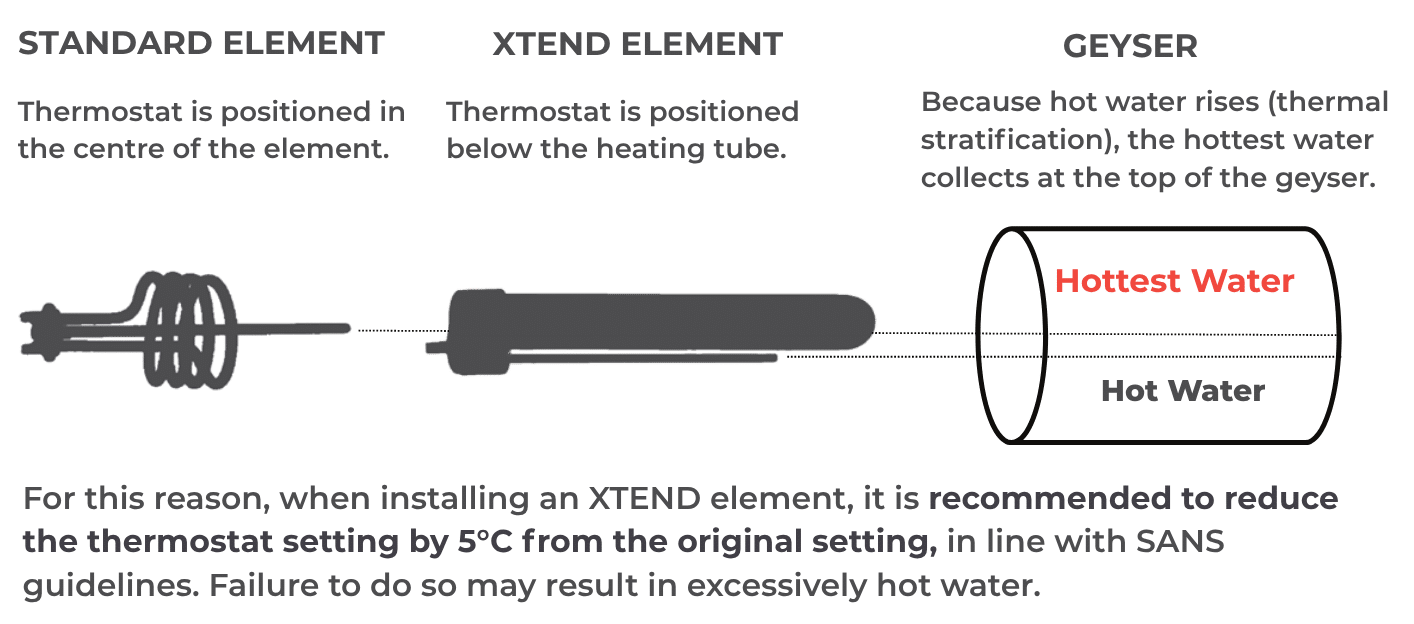
Some screw-in spiral elements have a thermostat pocket in the centre. The PTC design does not allow this. The thermostat pocket must be separate when the XTEND screw-in element is installed.
Some geysers have a separate pocket, and some have a spare port that can be used as a pocket. This requires some additional parts.
The thermostat setting will depend on the position relative to the element.
-
Turn the thermostat down 5°C from the original setting.
- Refit the two cables (live & neutral) to the thermostat and earth the geyser.
Setting the thermostat
Installation must be carried out by a qualified plumber
50mm Flange Mount Model
Install XTEND elements in the same manner as standard resistive elements.
-
Do NOT allow water to enter the grub screw hole during installation.
-
Tighten the grub screw firmly using the supplied Allen key.
-
When replacing an element, it is recommended to replace the thermostat and sacrificial anode(s) at the same time.
-
Handle the thermostat carefully — knocking or dropping it can cause it to fail.
35mm Boss / Screw-in Model
Some screw-in spiral elements have a thermostat pocket in the centre. The PTC design does not allow this. The thermostat pocket must be separate when the XTEND screw-in element is installed.
Some geysers have a separate pocket, and some have a spare port that can be used as a pocket. This requires some additional parts.
The thermostat setting will depend on the position relative to the element.
-
Turn the thermostat down 5°C from the original setting.
- Refit the two cables (live & neutral) to the thermostat and earth the geyser.
Setting the thermostat
Installation must be carried out by a qualified plumber.
50mm Flange Model
Install XTEND elements in the same manner as standard resistive elements.
-
-
Do NOT allow water to enter the grub screw hole during installation.
-
Tighten the grub screw firmly using the supplied Allen key.
-
When replacing an element, it is recommended to replace the thermostat and sacrificial anode(s) at the same time.
-
Handle the thermostat carefully — knocking or dropping it can cause it to fail.
-
35mm Boss / Screw-in Model
Some screw-in spiral elements have a thermostat pocket in the centre. The PTC design does not allow this. The thermostat pocket must be separate when the XTEND screw-in element is installed.
Some geysers have a separate pocket, and some have a spare port that can be used as a pocket. This requires some additional parts.
The thermostat setting will depend on the position relative to the element.
-
Turn the thermostat down 5°C from the original setting.
-
Refit the two cables (live & neutral) to the thermostat and earth the geyser.
Setting the thermostat
Troubleshooting Guide
Water not hot or lukewarm

If the geyser is not heating up, the following could be the cause:
1. Faulty mixing valve
2. Reverse thermosiphoning
3. Hot water leak
4. Ring main
5. Faulty timer or controller
6. Faulty thermostat
7. Faulty wiring or circuit breaker
8. Faulty element.
Please check all of the above before assuming it is the XTEND element.
Troubleshooting Guide
Water not Hot or Lukewarm
If the geyser is not heating up, the following could be the cause:
1. Faulty mixing valve
2. Reverse thermosiphoning
3. Hot water leak
4. Ring main
5. Faulty timer or controller
6. Faulty thermostat
7. Faulty wiring or circuit breaker
Please verify the troubleshooting steps above before concluding that the unit is faulty.
Tripping Earth Leakage or Circuit breaker

XTEND elements require a high current on start-up due to the ceramic chips inside needing more power upon start-up than standard resistive elements.
If the element is tripping, it could be due to any of the following:
1. Circuit breaker is faulty or very old
2. The wiring is loose around the circuit breaker
3. Connecting wires are too small or loose
4. The thermostat is faulty
5. The circuit breaker is too small
6. Dead short in the cable
7. Water inside the element will cause a short (This can trip the entire DB)
Please ensure the entire electrical circuit is checked for potential faults before returning the XTEND element as defective. The element is rarely the source of the malfunction.
For more information, you can always call our XTEND elements Hotline on 087 057 9126
Please verify the troubleshooting steps above before concluding that the unit is faulty.
Tripping the earth leakage or circuit breaker
XTEND elements require a high current on start-up due to the ceramic chips inside needing more power upon start-up than standard resistive elements.
If the element is tripping, it could be due to any of the following:
1. Circuit breaker is faulty or very old
2. The wiring is loose around the circuit breaker
3. Connecting wires are too small or loose
4. The thermostat is faulty
5. The circuit breaker is too small
6. Dead short in the cable
7. Water inside the element will cause a short (This can trip the entire DB)
Please ensure the entire electrical circuit is checked for potential faults before returning the XTEND element as defective. The element is rarely the source of the malfunction.